


Key takeaways
- Insurance companies are more likely to cover hair loss treatments when the hair loss is caused by an underlying medical condition, like an autoimmune disorder or cancer treatment, rather than cosmetic concerns like typical pattern baldness.
- Treatments such as minoxidil, finasteride, corticosteroid injections, and laser therapy can help with different types of hair loss, but coverage varies depending on the treatment and the specific insurance plan
- It is important to consult with a healthcare professional to determine the cause of hair loss and explore treatment options, and to contact your insurance provider to understand the extent of your coverage.
————–
Need a prescription or refill for male hair loss medication? You can get discreet and expert on-demand care in as little as 15 minutes through Optum Perks. For $39, answer a few questions online and get a treatment plan from a US-licensed healthcare professional. Get started here.

Overview
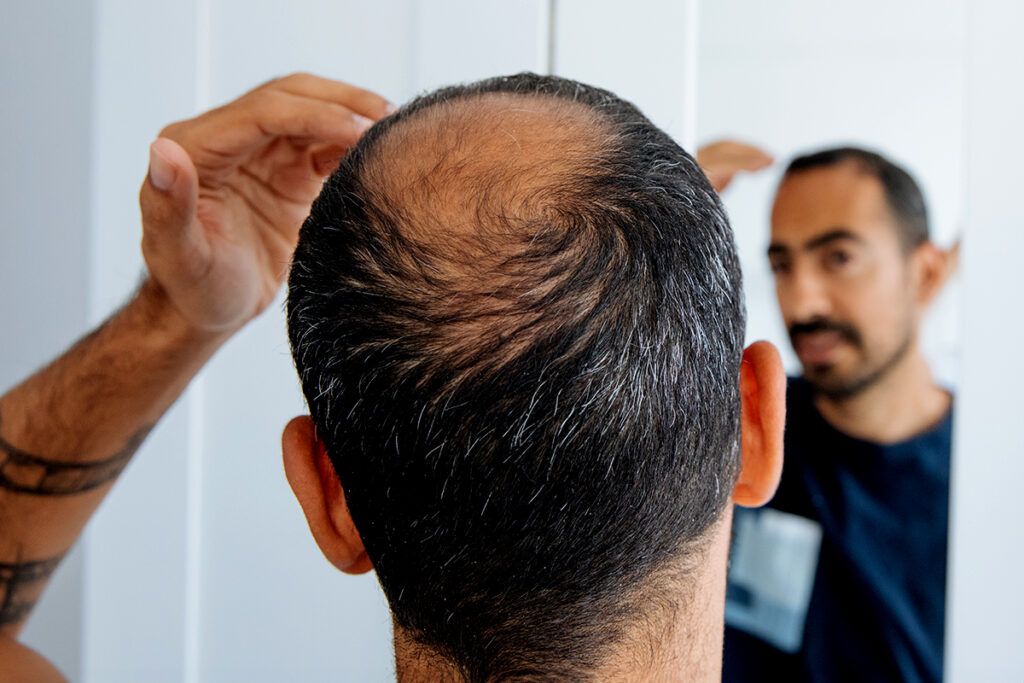
Hair loss is a relatively common condition that affects people regardless of gender, but it may occur for different reasons. You may find that the cause is androgenetic alopecia (pattern hair loss), the most common form.
For others, an underlying medical condition, medication therapy, or weight loss of 20 pounds or more may be the cause.
Whatever the reason, hair loss can lead to low self-esteem, depression, anxiety, and other mood disorders. There are treatments available, and your insurance may cover some of them.
Sex and gender exist on spectrums. This article uses the terms “male,” “female,” or both when discussing people assigned female or male at birth to reflect language that appears in source materials.
While gender is solely about how you identify yourself, independent of your physical body, you may need to consider how your personal circumstances will affect diagnosis, symptoms, and treatment.
Insurance and hair loss treatments
Health insurance doesn’t typically cover hair loss treatments if they’re purely for cosmetic reasons. This could be because pattern hair loss, receding hairlines, and age-related hair thinning are often expected.
However, hair loss due to chemotherapy, an autoimmune disorder, leukemia, or other medical conditions may justify insurance coverage for treatment.
You should always check your policy details or contact your insurance company to confirm coverage.
Hair loss types and causes
Hair loss can result from several factors, and treatments will vary depending on the cause.
Alopecia areata
Alopecia areata is an autoimmune condition where your immune system attacks and destroys healthy hair follicles.
This can happen if you have a family history of alopecia, or it can occur after a significant life event such as an illness or trauma.
Insurance may not cover treatment for alopecia areata, in part because some of the common treatments do not have Food and Drug Administration (FDA) approval for this purpose. In fact, a 2022 review suggested that insurers denied coverage for tofacitinib (Xeljanz) in 97% of cases.
However, if your insurer denies your claim, you may be able to appeal. According to the National Alopecia Areata Foundation, around 40% of appeals are successful, so it may be a good option to try.
Hair loss due to chemotherapy
This hair loss can be temporary, and hair may grow back on its own within a few months. Medical treatments can often encourage growth and reduce growth time.
Scalp cooling caps, for example, can help prevent or manage chemotherapy-induced alopecia. They have FDA approval, and some insurance plans may cover them.
Other reasons:
Other factors may lead to hair loss. Some of the common reasons may be:
- lack of nutrients
- long-term medication use
- genetics
- use of damaging hair products
- incorrect hair care
- childbirth
Hair loss treatments
Different treatment options are available for hair loss, and no one treatment works for everyone. Sometimes, a combination of treatments offers the best results. The treatment often depends on the reason for the hair loss.
Minoxidil (Rogaine)
This medication is available only by prescription. A doctor or healthcare professional will recommend it to stimulate hair growth and prevent further hair loss. They may advise using this medication during early hair loss stages.
Minoxidil (Rogaine) comes in a liquid form and an oral pill. You apply the liquid directly to your scalp to stimulate growth and slow hair loss. A starting dose may be half a capful of the 5% aerosol version of the drug directly onto your scalp.
The pill form of minoxidil is mainly used to treat high blood pressure (hypertension), and it’s not currently FDA-approved for hair loss. This might affect whether your insurance will cover the medication.
Still, doctors may prescribe it for this purpose due to encouraging clinical trial results. If a doctor prescribes a drug in this way, it is considered off-label use.
A prescribing doctor may start off-label dosing of oral minoxidil (Rogaine) for treating alopecia at 0.25 to 2.5 milligrams (mg), once or twice daily in 1 or 2 equal doses.
It’s important to follow the guidance of healthcare professionals carefully. Effects aren’t immediate — you may notice results after 4 months of taking minoxidil (Rogaine).
————-
If you need help covering the cost of medications, the free Optum Perks Discount Card could help you save up to 80% on prescription drugs. Plus, you can now get them delivered to your home in as little as 3 days. Search for your medication here.

Free prescription coupons
Seriously … free. Explore prices that beat the competition 70% of the time.
Get free cardFinasteride (Propecia)
This form of finasteride (Propecia) treats male pattern hair loss, which is the gradual thinning of the hair on the scalp, leading to a receding hairline or balding on the top of the head.
It’s an oral (pill) form and requires a prescription. A typical starting dose is 1 milligram (mg) taken once daily.
Corticosteroid injections
A small 2022 study looked at the effects of corticosteroid injections on alopecia areata. The results were encouraging, with more than 80% of participants experiencing regrowth of at least half of their hair within 12 weeks.
A dermatologist may administer corticosteroid injections into balding or thinning areas every 4 to 6 weeks, and you may notice some hair regrowth within 3 months.
Microneedling
Microneedling devices contain hundreds of tiny needles and stimulate hair growth.
According to the American Academy of Dermatology Association (AAD), microneedling may lead to significant hair growth, especially if used in conjunction with 5% minoxidil twice each day.
Laser therapy
Low level laser light therapy (LLLT) aims to promote hair growth.
You may consider LLLT at home or in a clinical setting, especially if you don’t want to take medication every day and are looking for safe and painless therapy.
A 2024 review found that every study included in its research noted positive effects of LLLT for both males and females with no side effects.
Stem cell therapy
In pattern hair loss (PHL), there are defects in and loss of specific cells, called progenitor cells.
However, the hair follicle stem cells remain healthy. Because the follicle stem cell is healthy, PHL becomes a reversible condition that healthcare professionals can use to regrow hair.
Regenera Activa is a new technology that collects mature stem cells, prepares them, and then injects the cell solution into the scalp.
As this is a newer treatment option, it can be very costly, but a small 2024 study suggests initial results are promising.
Help with costs
If you take prescription drugs for hair loss, you can check online for discount codes and coupons. Optum Perks, for example, offers finasteride (Propecia) and minoxidil (Rogaine) coupons for different pharmacies. These coupons can’t be used alongside insurance, so they may be a good option if insurance doesn’t cover your medication.
You may ask your doctor to prescribe durable medical equipment (DME) that you can use repeatedly in your home for a medical condition. This could include tools to stimulate blood flow to the area of hair loss, laser therapies, or laser caps.
Usually, for insurance to cover DME costs, the request needs to be written like a prescription from your doctor. Renting the equipment is also sometimes an option.
Contact your insurance company for information specific to your plan, including exclusions.
Online care for hair loss
It’s important to speak with a doctor or dermatologist about any hair changes you’re noticing. They can examine your hair to determine the cause and discuss your expectations about treatment options.
Always talk with a doctor about any current medications or supplements you’re taking to avoid drug interactions.
Online care services, including Optum Perks Online Care, may make getting treatment easier. With these services, you can submit an online form answering a few questions about your symptoms, and a US-licensed healthcare professional will respond soon after to prescribe a treatment plan.
Summary
Hair loss has many causes, but whether an insurance plan will cover the costs can depend on whether your hair loss is due to a medical condition or medication.
If you have pattern baldness, which can occur as part of the natural aging process, insurers will not usually cover associated treatment costs, as they may consider it cosmetic rather than medical.
If a doctor prescribes medication or equipment, like a laser light cap, for a qualifying medical condition, an insurer may cover some or all of the costs.
You can speak with your insurer to confirm your coverage and ensure you are not out of pocket.
—————
Download the free Optum Perks Discount Card to save up to 80% on many prescription medications. Plus, you can now get them delivered to your home in as little as 3 days. Search for your medication here.