


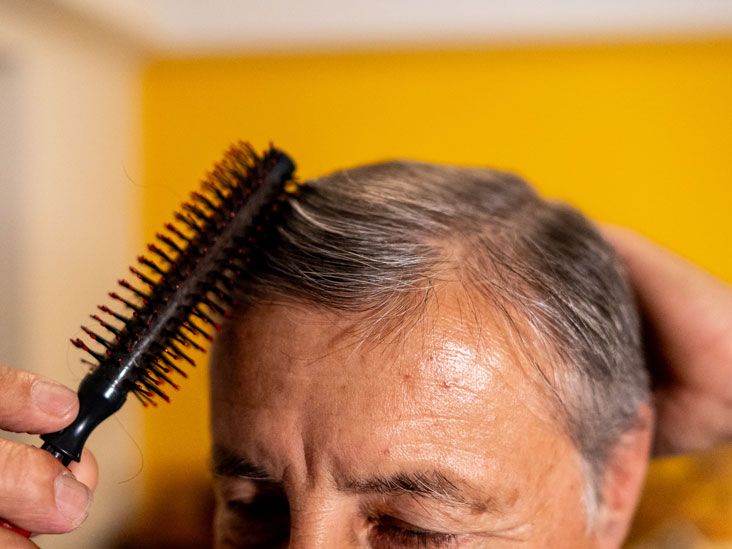
Male pattern baldness, also known as male androgenetic alopecia, refers to progressive hair loss on the scalp that increases with time, usually at the front of the head, and presents as a receding hairline.
The Food and Drug Administration (FDA) has approved many treatments for male pattern baldness. Some of these are even available without a prescription. Options include topical medications, oral medications, laser treatments, and even surgery.
It’s important to note that androgenetic alopecia can affect anyone regardless of sex, but it’s likely more common in males, affecting up to 50% of men by the age of 50 years. It’s the most common form of hair loss in men.
Sex and gender exist on spectrums. This article uses the terms “women,” “men,” or both when discussing people assigned female or male at birth to reflect language that appears in source materials.
While gender is solely about how you identify yourself, independent of your physical body, you may need to consider how your personal circumstances will affect diagnosis, symptoms, and treatment.
What causes male pattern baldness?
Male pattern baldness is the most common cause of hair loss in men.
It’s a highly hereditary condition, which means that if your parents have it, it’s likely that you will also develop it. This means that the main cause of male pattern baldness is genetics. These inherited genes affect how your hair follicles respond to certain hormones.
The condition is also linked to your hormones, specifically how your body responds to androgens — commonly known as the male sex hormones. The main androgen involved in pattern hair loss is dihydrotestosterone (DHT). Too much DHT can affect your hair’s growth cycle, leading to thinner hair.
It tends to develop slowly, causing thinning and hair loss over several years.
It’s important to note that there are other causes of hair loss in general, such as age and illness, but these are not the same condition as male pattern baldness.
Need a prescription or refill for male hair loss medication? You can get discreet and expert on-demand care in as little as 15 minutes through Optum Perks. For $29, answer a few questions online and get a treatment plan from a US-licensed healthcare professional. Get started here.

What are the treatments for male pattern baldness?
Although it isn’t necessary to treat pattern hair loss medically, and many people choose not to, the FDA has approved several different treatments for the condition.
Minoxidil
Topical minoxidil (Rogaine) comes as a solution or a foam that you apply directly to your scalp daily. It comes in 2% and 5% strengths and may be available over the counter.
Experts note that minoxidil may work by stimulating the circulation around your hair follicles, creating conditions that can help hair growth. It may also directly affect the growth cycle and stop the androgen-related effects on your hair.
It will likely take up to 8 weeks to notice results, with maximum effects after around 4 months. It’s important to note that hair loss will begin again when you stop taking minoxidil.
Minoxidil is generally well-tolerated. It may cause some irritation on the scalp, and in some people, it might cause further hair loss. You might notice this when starting minoxidil, but if you continue with treatment, it will eventually recover. Minoxidil isn’t associated with long-term side effects.
————-
If you need help covering the cost of medications, the free Optum Perks Discount Card could help you save up to 80% on prescription drugs. Plus, you can now get them delivered to your home in as little as 3 days. Search for your medication here.

Free prescription coupons
Seriously … free. Explore prices that beat the competition 70% of the time.
Get free cardFinasteride
Oral finasteride (Propecia) comes in oral tablet form. For androgenic alopecia, you take 1 milligram once per day. It’s a prescription medication, so you need to speak with a healthcare professional to receive it.
Finasteride works by stopping testosterone from being converted into DHT. However, it doesn’t completely get rid of DHT, so while it slows hair loss, it doesn’t stop altogether.
Like any medication, finasteride might cause some side effects. Because of how it affects your hormones, it may cause loss of libido and erectile dysfunction.
Laser treatments
Laser treatments, also known as low-level laser therapy (LLLT), are other options that may be effective in managing hair loss and are also FDA-approved for androgenetic alopecia. The treatment is available as a hood you put over your head or as a laser comb.
It works by using lasers to stimulate the growth phase in your hair follicles and promote repair on your scalp. Research from 2021 suggests that LLLT is safe and effective, and it may be even more effective when combined with topical minoxidil or oral finasteride.
Hair transplants
The most permanent solution for hair loss is a surgical hair transplant. This is where healthcare professionals move hair from one area of your scalp to another, where you are losing hair. This is a surgical procedure, so it is still associated with risks of surgery, like infection and scarring.
Are there any natural remedies?
Alongside FDA-approved medications, there are several natural compounds that may be able to help with hair growth.
Caffeine
Many shampoos contain caffeine because it may help reduce hair loss. For example, according to a 2018 research review, daily use of caffeine shampoo was associated with reduced hair loss and a slower rate of hair loss after 6 months.
Topical caffeine may also be effective when combined with minoxidil solutions.
Rosemary oil
Rosemary oil is a common method to promote hair growth. The 2018 review suggests that it may lead to a significant increase in hair growth after 6 months of use. The research cited suggests that it could be as effective as topical minoxidil.
Zinc supplements
People with androgenetic alopecia may also have low zinc levels. According to the 2018 research review, oral supplementation with zinc was associated with reduced alopecia severity.
Online care for male pattern baldness
Male pattern baldness is associated with significant effects on confidence and self-esteem. But many treatments are available that may help improve overall well-being.
Online care services, including Optum Perks Online Care, may make getting treatment easier. With these services, you can submit an online form answering a few questions about your symptoms, and a US-licensed healthcare professional will respond soon after to prescribe a treatment plan.
Summary
Male pattern baldness, also known as male androgenetic alopecia, is very common. It’s associated with thinning hair on the scalp and a receding hairline. It can have a great effect on mental health as well as physical appearance.
The FDA has approved several treatment methods. Minoxidil is a topical medication, and finasteride is an oral tablet. Other options include laser therapy or a hair transplant.
Some natural remedies may also stimulate hair growth or slow hair loss.
—————
Download the free Optum Perks Discount Card to save up to 80% on many prescription medications. Plus, you can now get them delivered to your home in as little as 3 days. Search for your medication here.